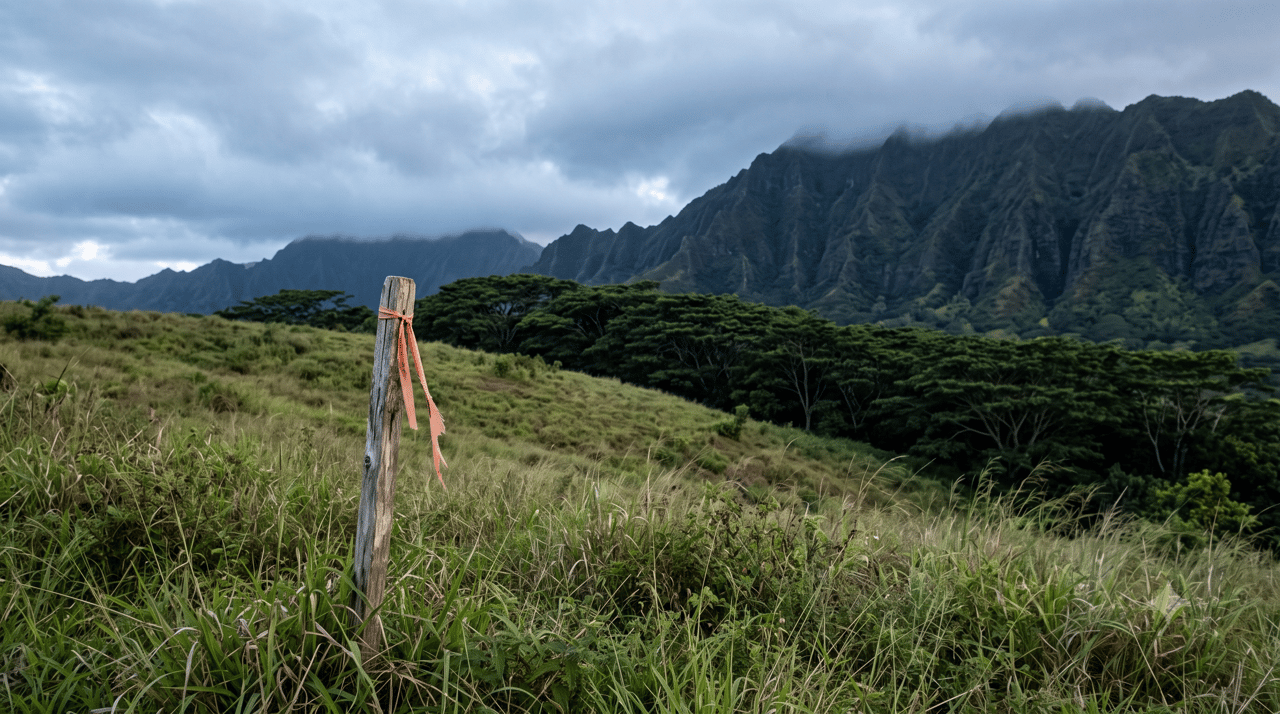
If you've driven through Kalaheo Hillside past the high school, you've gone by it without thinking about it. Ten acres of open grass off Iliaina Street, quiet and empty, doing nothing in particular since 1961. The city has owned it that whole time. It was supposed to be an elementary school once. That never happened either.
Two years ago the parcel finally had a real future lined up — Kailua's first Hawaiian homestead community, 20 to 35 single-family homes for Native Hawaiian beneficiaries who have been waiting decades for a lot of their own. Last week that plan died. What killed it was the dirt.
Two Years of Homework, One Bad Answer
In 2024, the Honolulu City Council passed a resolution clearing the way to hand the land over to the Department of Hawaiian Home Lands. The transfer came with a condition: DHHL had to do its homework first. That meant a preliminary engineering report covering topography, soil conditions, and everything else you'd want to know before putting houses on a hillside.
The report came back and the answer was no. Kali Watson, chairman of the Hawaiian Homes Commission, wrote to the city last week that the extremely expansive soil conditions at the former Kalaheo Elementary School site make it unsuitable for homestead development.
"Expansive soil" is the polite term for clay that can't sit still. It swells when it gets wet and shrinks when it dries, and on the windward side it gets wet a lot. Ground that moves like that will crack a slab, tilt a foundation, and turn a front door into a seasonal thing. You can engineer around it — deeper footings, post-tension slabs, soil replacement — but the cost climbs fast, and it climbs fastest on exactly the kind of housing that can least afford it.
The Neighbors Had Been Saying This For a While
Anyone who sat through a Kailua Neighborhood Board meeting on this one isn't shocked. Residents raised the soil question early and kept raising it, along with doubts about whether the water and sewer lines could carry another twenty-plus homes. Most of Kalaheo Hillside went up in the late '50s and early '60s, and a few of those houses have their own foundation stories to tell.
Council Member Esther Kiaʻāina, who represents the area and co-authored the 2024 resolution, took it straight. If the ground is a problem for DHHL, she said, it's a problem for anybody — so she plans to work with the city administration on downzoning the property to preservation. She's disappointed. She also doesn't want a future council member walking into the same wall.
Ten Acres, $10.45 Million, and a Lesson About "Buildable"
The land is assessed at $10.45 million and would have gone to DHHL at no cost. Now it stays with the City and County, still zoned residential, at least until the preservation conversation goes somewhere.
That gap — zoned residential, not actually buildable — is one of the more expensive lessons on this island. Zoning tells you what the map allows. It doesn't tell you what the ground will hold, whether the sewer has capacity, or what a geotechnical engineer will say once the drilling is done. We see the small version of this constantly on windward and hillside lots. The parcel looks fine, the report says otherwise, and the number changes.
If you own on this side of the island and you've got hairline cracks walking across your slab, or a door that sticks every winter and behaves every summer, that's the same soil having the same argument with your house.
The Waitlist Doesn't Care About Any of This
Here's the part that stings. Roughly 29,000 applicants sit on DHHL's statewide waitlist, and more than 11,000 of them are on Oʻahu's residential list alone. Money isn't the bottleneck it used to be — the Legislature put $600 million toward homestead development in 2022. Land is. Good land, close to town, near schools and jobs, that will hold a house.
And the work is moving. Just days before this letter went out, DHHL awarded 815 project leases on Oʻahu — 400 in Waimānalo, 400 in ʻEwa, 15 in Nānākuli. This particular ten acres just wasn't going to be part of it.
Watson said the department will keep working with the city to find other publicly owned parcels that might pencil out. Kiaʻāina framed it about the way it should be framed: the objective isn't only homesteads. It's more housing units, period, with homes for Native Hawaiian families a priority inside that.
The honest read is that the process worked, even though nobody got what they wanted. Far better to learn this on paper in 2026 than to learn it through thirty cracked foundations in 2040. Still, it's hard to look at that quiet green slope above Kalaheo High and not think about how many families were counting on it — and how few places are left on this island where the answer is simply yes.