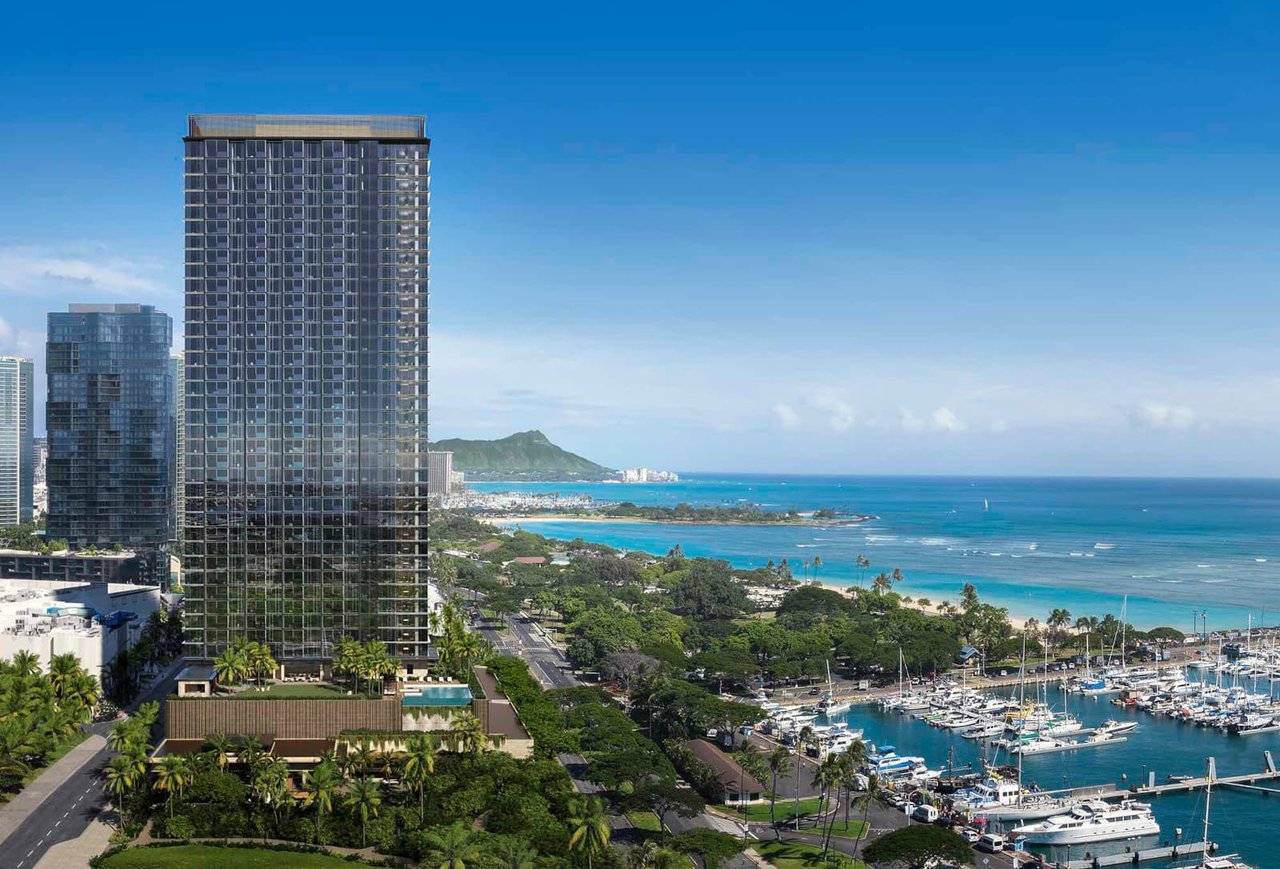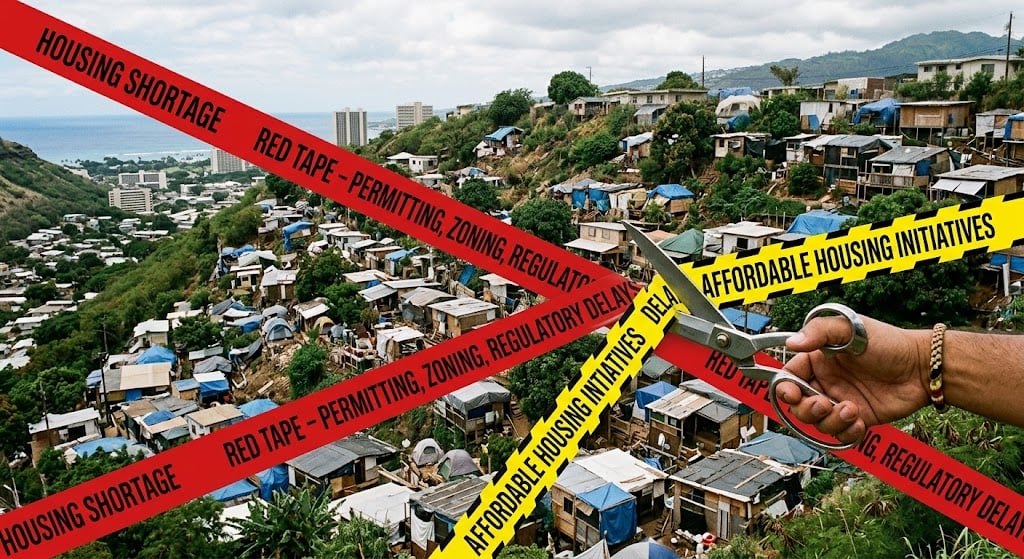
It’s no secret that living in Hawai‘i feels like a beautiful, sun-drenched uphill climb. We love this place—the community, the food, the surf—but the math just isn’t adding up for a lot of people anymore. For decades, we’ve watched friends and cousins pack up for the mainland because the dream of owning a home here feels more like a fantasy.
A new policy brief from the Grassroot Institute of Hawaii, titled the Hawaii Housing Policy Playbook, lays out exactly why things got so expensive and, more importantly, how we can fix it. The report argues that our housing crisis isn't an accident; it’s the result of decades of regulations that stifle homebuilding.
If we want to stop the "out-migration" of our local families, we need to move past "tinkering at the margins" and take some bold action. Here’s a breakdown of the playbook’s ten-point plan to make housing abundant and affordable again.
1. Shrinking the Footprint: Reducing Lot Sizes
In a state where land costs are a primary driver of high housing prices, current rules dictate the minimum size of parcels for single-family homes. In Honolulu, the minimum is 3,500 square feet, while in Hawai'i County, it reaches 7,500 square feet. These mandates often incentivize "monster homes" over smaller, affordable "starter" homes. The playbook suggests reducing these minimums to boost supply, noting that Houston, Texas, successfully used this strategy to build approximately 80,000 homes on smaller lots.
2. Ending the Parking Tax
Adding just one parking space in a Honolulu garage costs roughly $68,000. Hawaii's counties generally require a specific number of parking spaces for new buildings, which drives up rent and makes walkable communities harder to establish. The recommendation is to abolish these mandates, or at least exempt areas near transit hubs, to lower construction costs.
3. Rethinking Inclusionary Zoning
Inclusionary zoning requires developers to offer some units at below-market rates, but studies show it often makes projects financially unfeasible, leading to stagnant housing growth. Despite having several such programs in Hawaii, they have done little to improve affordability. Lawmakers are encouraged to eliminate these programs and focus on reforms that encourage growth at all levels.
4. A Single, Faster Building Code
Hawaii's fragmented building code process creates confusion and drives up costs as builders navigate up to four different sets of rules. The playbook recommends a single statewide building code to eliminate the need for separate county adoptions. Additionally, moving to a six-year update cycle instead of three would let staff prioritize permit approvals.
5. Embracing Prefab and Modular Homes
Prefabricated and manufactured homes are common on the mainland but face unfriendly zoning and complicated permitting in Hawai'i. These homes are often cited by owners for their affordability and quality. The brief suggests creating a standard, streamlined permitting process for federally certified manufactured housing to provide more low-cost options.
6. The "Missing Middle": Triplexes and Fourplexes
Small-scale multi-family housing like triplexes are currently forced to meet commercial building codes intended for high-occupancy structures. This requires expensive commercial-grade features like fire sprinklers, making these "missing middle" homes financially unfeasible. The recommendation is to place these buildings under the International Residential Code instead
7. Housing for Our Farmers
Farmers and ranchers struggle to find workers due to high housing costs, yet building on-site employee housing involves complicated approvals and expensive infrastructure. The playbook suggests adding flexibility to county zoning for employee housing and expanding permit exemptions for nonhabitable structures like greenhouses.
8. Reforming the Land Use Commission (LUC)
Hawaii is the only state with a statewide land-use classification system where larger projects must go through the Land Use Commission. This process is often lengthy, complex, and duplicates county-level work. Increasing the acreage cap on district boundary amendments would allow counties to handle more approvals, expediting the process for housing developments.
9. Helping the "Owner-Builder"
Current state law prevents owner-builders from leasing or selling a home within one year of construction. This limits residents from building accessory dwelling units (ADUs) or backyard cottages if they intend to rent them out immediately. Expanding the law to allow immediate leasing would give homeowners an extra tool to expand housing options.
10. Fixing the Hiring Bottleneck
State and county agencies often struggle with poor pay scales and inefficient hiring processes for permitting staff. While emergency orders have allowed some bypassing of these rules, they are not permanent law. Creating a permanent civil service exemption for agencies handling housing plans would provide the certainty needed to fill vacant jobs and speed up permit approvals.
The Bottom Line
Hawaii’s housing crisis will not improve until housing becomes more abundant. By adopting these reforms, lawmakers can move toward policies shown to meaningfully expand the housing supply and stabilize prices so that local families can afford a future in the islands.